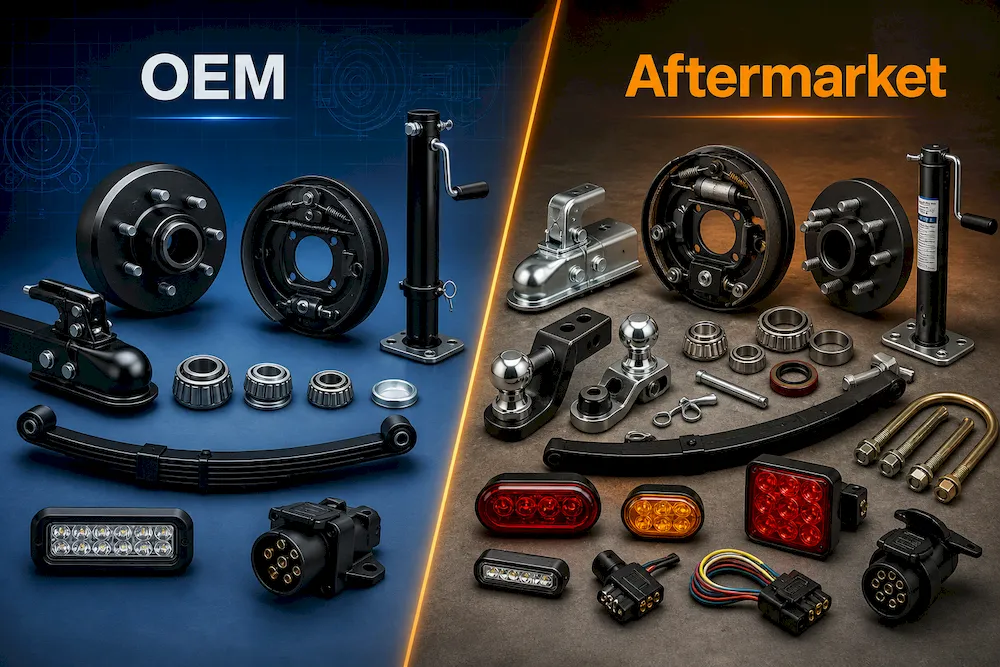
When buying trailer parts, many business owners face one common question: should we choose OEM trailer parts or aftermarket trailer parts?
This question is important for trailer manufacturers, repair shops, parts distributors, fleet owners, and transport companies. The right choice can affect cost, safety, repair time, product quality, and long-term business value.
OEM parts and aftermarket parts can both be good choices. But they are not always suitable for the same situation. To make the best decision, you need to understand the difference between them, their advantages, their limits, and how they fit your business needs.
In this article, we will explain OEM vs aftermarket trailer parts in simple language.
What Are OEM Trailer Parts?
OEM means Original Equipment Manufacturer. OEM trailer parts are made by the original manufacturer or made according to the original manufacturer’s standards.
For example, if a trailer was built with a specific axle, brake, coupler, jack, or suspension system, an OEM replacement part is designed to match that original part.
OEM trailer parts are usually made to fit the original trailer design as closely as possible.
Common OEM Trailer Parts
OEM trailer parts may include:
- Trailer axles
- Hubs and bearings
- Brake parts
- Suspension parts
- Leaf springs
- Couplers
- Jacks
- Lights
- Wiring harnesses
- Fenders
- Hinges
- Door hardware
For trailer builders and fleet owners, OEM parts are often used when exact fit and original performance are very important.
What Are Aftermarket Trailer Parts?
Aftermarket trailer parts are parts made by companies other than the original manufacturer. These parts are designed to replace, upgrade, or work with existing trailer systems.
Aftermarket parts may follow the same size and function as OEM parts, but they may come from different brands or suppliers.
Some aftermarket parts are made for general use. Some are designed as direct replacements. Others are made as upgraded versions with better materials, higher load ratings, or improved design.
Common Aftermarket Trailer Parts
Aftermarket parts can also include:
- Replacement axles
- Brake assemblies
- Bearings and seals
- LED trailer lights
- Couplers and hitches
- Trailer jacks
- Suspension kits
- Tie-down parts
- Toolboxes
- Ramp parts
- Spare tire carriers
- Wiring connectors
Aftermarket trailer parts are common in repair, maintenance, customization, and cost-controlled purchasing.
Main Differences Between OEM and Aftermarket Trailer Parts
OEM and aftermarket trailer parts may look similar, but there are some key differences.
Fit and Compatibility
OEM parts are designed to match the original trailer specifications. This usually means they are easier to install and have fewer compatibility problems.
Aftermarket parts may also fit well, but buyers must check size, load rating, mounting points, and technical details carefully.
Price
OEM parts are often more expensive because they follow original specifications and may come from the trailer manufacturer’s supply chain.
Aftermarket parts are usually more flexible in price. Some are cheaper, while high-performance aftermarket parts may cost more than OEM parts.
Availability
OEM parts may not always be easy to find, especially for older trailer models or special designs.
Aftermarket parts are often easier to source from many suppliers. This can help reduce repair waiting time.
Quality Range
OEM parts usually offer stable quality because they follow original standards.
Aftermarket parts have a wider quality range. Some are very good, while others may be low quality. This means supplier selection is very important.
Custom Options
OEM parts are normally made to match the original design.
Aftermarket parts may offer more options, including stronger materials, different finishes, improved designs, or custom manufacturing.
Advantages of OEM Trailer Parts
OEM trailer parts can be a strong choice for many businesses, especially when original fit and stable performance are important.
Exact Fit
The biggest advantage of OEM parts is fit. Since OEM parts are designed based on the original trailer specifications, they usually install smoothly.
This helps reduce:
- Installation mistakes
- Extra modification work
- Compatibility issues
- Repair delays
For repair shops, easy installation can save labor time.
Stable Performance
OEM parts are made to meet the original performance requirements. This gives buyers more confidence that the trailer will work as expected after replacement.
For fleet owners, stable performance is important because trailers need to work safely every day.
Lower Risk for Warranty Work
If a trailer is still under warranty, using OEM parts may help avoid warranty problems. Some trailer manufacturers may require OEM parts for certain repairs.
This is important for new trailers or high-value commercial trailers.
Good for Standard Repairs
When the goal is to return the trailer to its original condition, OEM parts are often a safe choice.
They are useful for:
- Warranty repairs
- Dealer service
- Standard replacement
- New trailer maintenance
- Parts with strict fit requirements
Disadvantages of OEM Trailer Parts
OEM parts also have some limits. They may not be the best choice for every business.
Higher Cost
OEM trailer parts are often more expensive than aftermarket options. For businesses managing many trailers, this can increase repair and maintenance costs.
If a fleet needs frequent replacement parts, high OEM prices may affect the budget.
Limited Supplier Options
OEM parts may only be available from the original manufacturer or authorized channels. This can make purchasing less flexible.
If the part is out of stock, the trailer may stay unused for a longer time.
Less Flexibility
OEM parts are designed to match the original setup. If your business wants to upgrade performance or customize a trailer, OEM parts may not offer enough options.
For example, you may want stronger lights, heavier-duty jacks, better corrosion protection, or improved tie-down systems. Aftermarket options may provide more choices.
Advantages of Aftermarket Trailer Parts
Aftermarket trailer parts are widely used because they offer flexibility, availability, and cost control.
More Price Choices
Aftermarket parts come in many price levels. This gives businesses more control over their purchasing budget.
For example, a fleet owner may choose standard aftermarket parts for light-duty trailers and premium aftermarket parts for heavy-duty trailers.
Easier Availability
Many aftermarket trailer parts are widely available. If a trailer needs a quick repair, aftermarket parts may help reduce downtime.
This is very important for:
- Fleet operators
- Transport companies
- Repair shops
- Trailer rental businesses
- Parts distributors
Fast access to parts means trailers can return to work sooner.
More Product Options
Aftermarket suppliers often offer many versions of the same type of part. Buyers can choose based on material, finish, size, strength, and design.
For example, you may find:
- LED lights instead of standard lights
- Galvanized parts for better rust resistance
- Heavy-duty jacks with higher load capacity
- Upgraded suspension parts
- Custom tie-down systems
- Better sealed bearings
This makes aftermarket parts useful for upgrades and special applications.
Good for Older Trailers
For older trailer models, OEM parts may be hard to find or no longer produced. Aftermarket parts can be a practical solution.
A good aftermarket supplier may help match the old part by size, drawing, sample, or technical details.
Disadvantages of Aftermarket Trailer Parts
Aftermarket parts can be very useful, but buyers need to be careful.
Quality Is Not Always the Same
The biggest risk of aftermarket parts is unstable quality. Different suppliers may use different materials, production methods, and quality control levels.
A low-quality aftermarket part may cause:
- Fast wear
- Poor fit
- Rust problems
- Weak load capacity
- Safety risks
- More frequent replacement
That is why it is important to choose reliable suppliers.
Compatibility Needs Careful Checking
Aftermarket parts may not always fit perfectly. Even small differences in size, holes, brackets, or connectors can cause problems.
Before buying, check:
- Part dimensions
- Load rating
- Mounting hole distance
- Bolt pattern
- Trailer model
- Material thickness
- Wiring connector type
- Brake or axle compatibility
For B2B buyers, technical drawings and samples can help reduce mistakes.
Warranty Concerns
Some manufacturers may not accept warranty claims if non-OEM parts are used. This depends on the trailer brand, the part, and the warranty terms.
For newer trailers, always check warranty requirements before using aftermarket parts.
Which Option Is Better for Fleet Owners?
For fleet owners, the best choice depends on trailer age, use, repair needs, and budget.
Choose OEM Parts When:
OEM parts may be better when:
- The trailer is new
- The trailer is still under warranty
- Exact fit is very important
- The part affects safety or core performance
- You want to keep the trailer close to original condition
- You need stable standard repair quality
OEM parts are often a safe choice for critical systems such as brakes, axles, hubs, and special structural parts.
Choose Aftermarket Parts When:
Aftermarket parts may be better when:
- You need faster availability
- You want lower purchasing costs
- The trailer is older
- OEM parts are hard to find
- You want an upgraded part
- You need custom options
- You already trust the aftermarket supplier
For items like LED lights, tie-down accessories, jacks, toolboxes, wiring parts, and protection accessories, aftermarket options can be very practical.
Which Option Is Better for Trailer Parts Distributors?
Distributors often need to balance quality, price, stock, and customer demand.
OEM Parts for Brand Trust
OEM parts can help distributors serve customers who need original replacement parts. They are useful for customers who care most about exact fit and warranty.
However, OEM parts may limit profit margins and supplier flexibility.
Aftermarket Parts for Wider Market Demand
Aftermarket parts can help distributors serve a larger customer base. They can offer different price levels, more product types, and faster inventory turnover.
For distributors, a strong aftermarket product line can create more business opportunities, especially if quality is stable.
Which Option Is Better for Trailer Manufacturers?
Trailer manufacturers may use OEM-style parts, custom parts, or aftermarket supplier parts depending on production needs.
Focus on Consistency
For trailer manufacturers, consistency is very important. Parts must fit the production line and meet safety requirements.
Whether the supplier is OEM or aftermarket, the key points are:
- Stable quality
- Correct specifications
- On-time delivery
- Custom manufacturing ability
- Reliable inspection process
- Long-term cooperation
A good supplier can help improve production efficiency and reduce after-sales problems.
How to Choose the Right Trailer Parts Supplier
No matter which option you choose, supplier quality is very important.
Check Product Specifications
A good supplier should provide clear product information, such as:
- Size
- Material
- Load rating
- Finish
- Application
- Packaging
- Technical drawings
- Installation details
Clear specifications help buyers make better decisions.
Check Quality Control
For business buyers, quality control should not be ignored. Ask about inspection processes, material control, welding quality, surface treatment, and packaging standards.
Stable quality is more important than one-time low price.
Check Customization Ability
If your business needs special trailer parts, choose a supplier that can support OEM or custom production.
This may include:
- Custom size
- Custom material
- Custom surface finish
- Custom packaging
- Logo or brand support
- Drawing-based production
- Sample-based production
Final Thoughts
OEM and aftermarket trailer parts both have advantages. OEM parts are usually better for exact fit, original performance, and warranty-related repairs. Aftermarket parts are often better for cost control, availability, upgrades, and older trailers.
For many businesses, the best solution is not choosing only one option. A smart purchasing strategy can use OEM parts for critical repairs and trusted aftermarket parts for regular maintenance, accessories, and upgrades.
The most important thing is to choose parts that are safe, compatible, durable, and suitable for your trailer application. Whether OEM or aftermarket, reliable quality and a trustworthy supplier will always matter most.